AYOUS

Family : MALVACEAE
Scientific name : TRIPLOCHITON SCLEROXYLON

WOOD DESCRIPTION

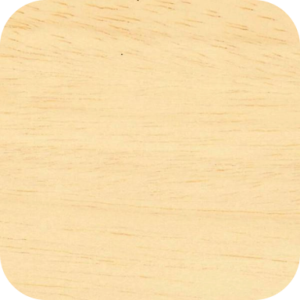
  • Reference colour: light yellow –
  • Sapwood: not distinct –
  • Grain: medium
  • Thread: straight or counter-thread
  • Counter grain: light

Black pitting, soft heartwood, mulotage or rutting in some logs. Yellowish white to light yellow, heartwood sometimes darker. Ribboned appearance on quarters. Sometimes irregular grain.
PHYSICAL AND MECHANICAL PROPERTIES

These properties can vary significantly depending on the origin and growing conditions of the wood.

  • Density*: 0.38
  • Monnin* hardness: 1.1
  • Volume shrinkage coefficient: 0.36
  • Stability in service: moderately stable to stable
  • Total radial shrinkage: 2.9
  • Fibre saturation point: 29 –
  • Total tangential shrinkage: 5.0
    (*: 12% moisture content)

NATURAL DURABILITY AND IMPREGNABILITY OF WOOD

  • Fungi: class 5 – not durable
  • Dry wood insects: susceptible; little or no distinct sapwood (risk throughout the wood)
  • Termites: class S – sensitive
  • Impregnability: 3 – poorly impregnable
  • Biological risk class: 1 – out of contact with the ground, sheltered (no risk of wetting)

Sensitive to blue stain and overheating

SAWING AND MACHINING

  • Sharpening effect: normal
  • Saw teeth: ordinary or alloy steel
  • Machining tools: ordinary

Crumbles when end machined and breaks when mortised. Pore plugging recommended.

ASSEMBLY

  •  Nailing – Screwing: poor resistance –
  • Gluing: correct
  • Gluing requires care: absorbent wood.

END-USES

Replaces poplar (Populus spp.) in many applications: light furniture. –

  • moulding
  • furniture
  • packing and crating
  • interior joinery
  • panelling –
  • sculpture

The main known uses should be confirmed by using the product in accordance with good practice. Important note: some uses are listed for information only.

REACTION TO FIRE

  • Conventional French classification :
    thickness > 14 mm: M.3 (moderately flammable)
    thickness < 14 mm: M.4 (highly flammable)
  • Classification according to Euroclasses: D s2 d0
    This default classification applies to solid wood meeting the requirements of standard NF EN 14081-1 annex C (May 2006), used in vertical walls. In other words, classified structural timber with a minimum average density of 0.35 and a minimum thickness of 22 mm.